
Your First 20 Useful Words
Now that you have a first feeling for pinyin and tones, it is time to learn a small group of words you can actually use.
The goal here is not to memorize a long vocabulary list.
The goal is to meet a few useful words that appear again and again in beginner Mandarin.
To make this easier, we will group them by function.
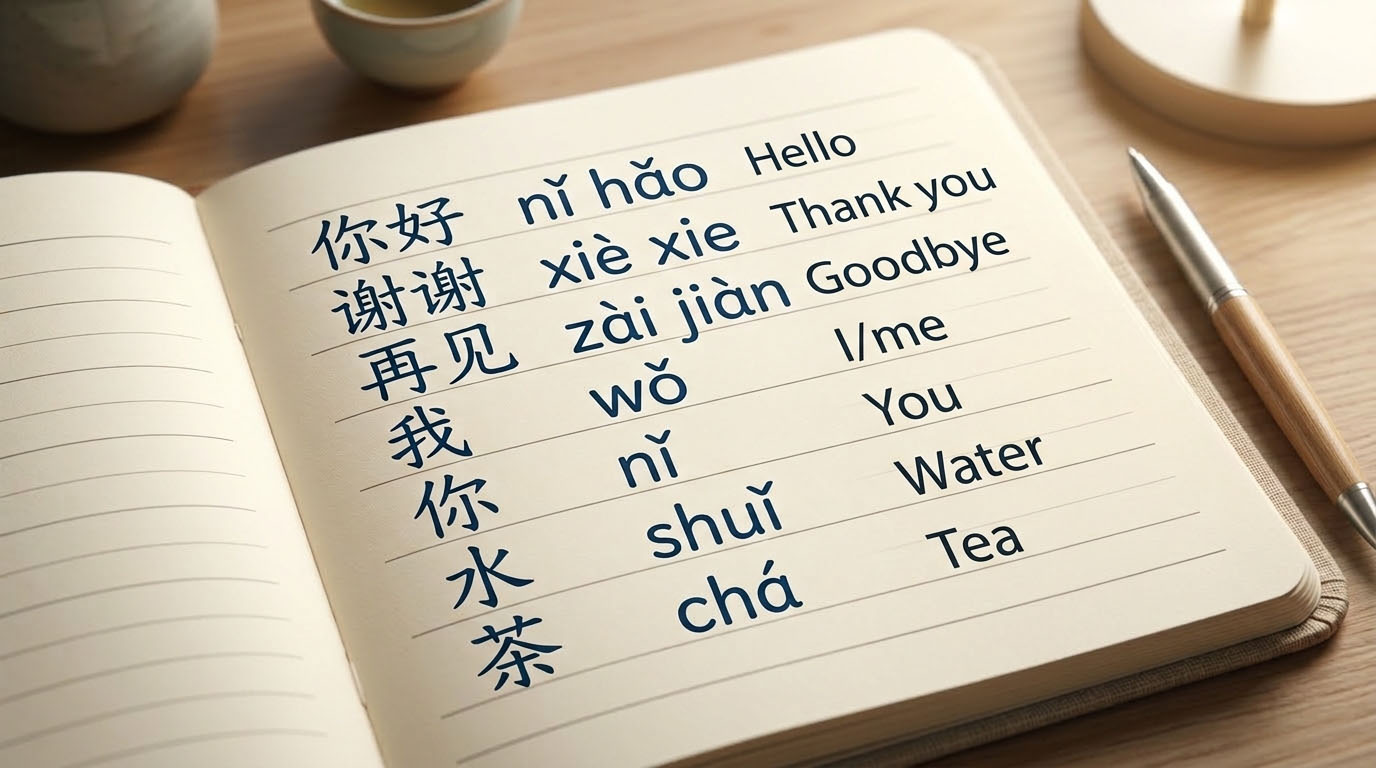
1. Basic social words
1) 你好
nǐ hǎo
hello
This is the most famous beginner phrase in Mandarin.
It literally combines “you” and “good,” but in daily use it simply means “hello.”
2) 谢谢
xiè xie
thank you
One of the most useful words from day one.
You will use it constantly.
3) 再见
zài jiàn
goodbye
A standard and clear way to say goodbye.
4) 请
qǐng
please / please do
This is a small but important polite word.
It often appears when asking someone to do something or offering courtesy.
5) 对不起
duì bu qǐ
sorry
Useful when you need to apologize or show politeness after a mistake.
2. Yes / no / basic response words
6) 是
shì
yes / to be
This is one of the most important beginner words.
It can mean “yes” in some contexts, and it is also the verb “to be.”
7) 不是
bú shì
no / is not
A very useful negative form.
It helps you reject, deny, or correct something simply.
8) 有
yǒu
have / there is
This word appears constantly in daily Mandarin.
9) 没有
méi yǒu
do not have / there is not
A core negative expression that beginners should learn early.
10) 好
hǎo
good / okay
One of the most flexible words in Mandarin.
It can mean good, okay, fine, or ready, depending on context.
3. People and identity
11) 我
wǒ
I / me
You need this immediately for self-introduction and simple sentences.
12) 你
nǐ
you
Another core beginner word.
It appears everywhere.
13) 他
tā
he / him
A useful third-person word.
14) 她
tā
she / her
Spoken Mandarin pronounces this the same way as 他.
The difference is visible in writing.
15) 老师
lǎo shī
teacher
A very common and respectful word in learning contexts.
4. Daily practical words
16) 水
shuǐ
water
Simple, useful, and easy to notice in real life.
17) 茶
chá
tea
An excellent beginner word, especially in your wider cultural context.
18) 饭
fàn
meal / rice / food
A very common daily-life word.
19) 钱
qián
money
Useful in shopping and travel situations.
20) 路
lù
road / way
A practical beginner word that connects naturally to asking directions later.
How to learn these 20 words well
Do not try to memorize all 20 at once.
Instead, do this:
Step 1
Read them in groups, not as one long list.
Step 2
Say each word aloud slowly two or three times.
Step 3
Choose five words that feel most useful to you right now.
Step 4
Come back and repeat the list again later.
A small number of words repeated well is much more valuable than a large list you forget immediately.
What matters most right now
At this stage, you do not need perfect pronunciation.
You do not need full grammar.
And you do not need to build long sentences yet.
What matters is this:
①you can recognize these words
②you can say some of them with growing confidence
③you begin to feel that Mandarin is becoming usable
That feeling is important.
Because once the language starts to feel usable, it starts to feel less distant.
Quick review list
- 你好 — nǐ hǎo — hello
- 谢谢 — xiè xie — thank you
- 再见 — zài jiàn — goodbye
- 请 — qǐng — please
- 对不起 — duì bu qǐ — sorry
- 是 — shì — yes / to be
- 不是 — bú shì — no / is not
- 有 — yǒu — have
- 没有 — méi yǒu — do not have
- 好 — hǎo — good / okay
- 我 — wǒ — I
- 你 — nǐ — you
- 他 — tā — he
- 她 — tā — she
- 老师 — lǎo shī — teacher
- 水 — shuǐ — water
- 茶 — chá — tea
- 饭 — fàn — meal / food
- 钱 — qián — money
- 路 — lù — road / way
Ending
These are only your first 20 words, but they already give you a small working beginning.
In the next lesson, we will turn this growing confidence into something even more practical:
Beginner Pronunciation Sheet.