
Names and Titles in Chinese
One of the easiest ways to sound unnatural in a new language is to address people the wrong way.
This is especially true in Chinese.
In English, many learners are used to a simple pattern:
first name, last name, maybe “Mr.” or “Ms.” when needed.
But in Chinese, names and titles often carry a stronger sense of relationship, respect, and social position.
That means something important for beginners:
learning how to address people is part of learning how to sound polite.
The good news is that you do not need to master every nuance.
You only need a few safe patterns.
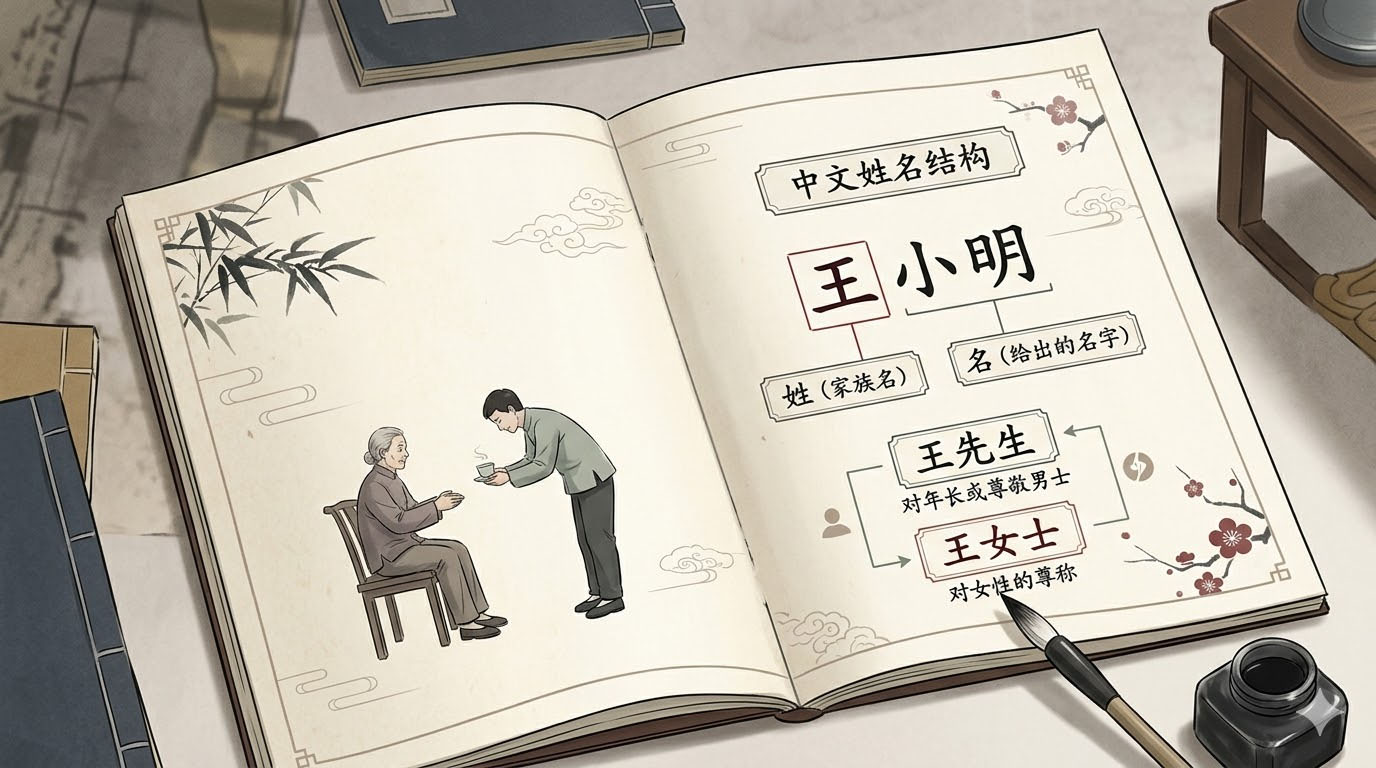
1. Family name comes first
In Chinese, the family name usually comes before the given name.
For example:
王小明
Family name: 王
Given name: 小明
This is the opposite of the usual English order.
So when you meet a Chinese name, it helps to remember:
family name first, personal name second
This small shift makes many things easier.
2. Do not assume first-name familiarity
In English-speaking situations, using someone’s first name can feel friendly and normal.
In Chinese, the situation may be different.
Using only a given name may sound:
- too casual
- too familiar
- too intimate
- or simply not the safest beginner choice
That does not mean people never do it.
It means beginners should be careful.
A safer strategy is often:
- use the full name
- or use family name + title
- or use a role title
3. Teacher is one of the most useful titles
One of the safest and most useful titles for beginners is:
老师
teacher
This is extremely common in learning environments.
It sounds natural, respectful, and easy to use.
Examples:
- 王老师
- 李老师
- 老师好
This is much better than guessing how formal or casual to be.
If someone is your teacher, calling them 老师 is usually a very safe choice.
4. Common role-based titles
Chinese often uses role or relationship titles in ways that may feel stronger than in English.
For beginners, this is useful because titles can help you stay polite without overthinking.
Examples include:
- 老师 — teacher
- 医生 — doctor
- 经理 — manager
- 先生 — Mr. / sir
- 女士 — Ms. / madam
At beginner level, you do not need to use all of them actively.
But it is useful to recognize them.
5. Family name + title is a safe pattern
One of the most practical patterns in polite Mandarin is:
family name + title
Examples:
- 王老师
- 李先生
- 张女士
This often sounds more natural than using a full English-style naming pattern.
For a beginner, this is a very useful idea:
you do not always need a complex sentence to sound respectful.
Sometimes the right title already does the work.
6. What about full names?
Using a full Chinese name is not wrong.
But in real life, full-name use depends on context.
It may sound:
- neutral
- formal
- identifying
- less natural in repeated direct address
That is why, for beginners, full names are useful for recognition, but titles are often safer for direct interaction.
So a good beginner rule is:
Recognize full names
but
use titles carefully and respectfully
7. What about “你” and “您”?
This is also part of politeness.
你
the normal word for “you”
您
a more respectful form of “you”
Beginners do not need to force 您 into every sentence.
But it is useful to know that it exists and may appear in service, formal, or respectful contexts.
If you want a very simple beginner rule:
- 你 is the normal everyday form
- 您 is the more respectful form
8. A safe beginner strategy
If you are unsure how to address someone in Chinese, try this order:
Option 1
Use a role title
Example: 老师
Option 2
Use family name + title
Example: 王老师
Option 3
Use a polite greeting first
Example: 你好,老师
This is much safer than trying to sound overly familiar too early.
9. What matters most right now
At beginner level, you do not need to master the full social system of names and titles.
What matters is that you begin to notice:
- names are ordered differently
- titles matter
- direct familiarity is not always safest
- role-based address is often useful
That awareness alone already makes your Mandarin more natural.
Quick Review
Key ideas
- Chinese names usually begin with the family name
- Titles are important in polite speech
- Given-name familiarity is not always the safest beginner choice
- Family name + title is often a useful pattern
Useful examples
- 王老师
- 李先生
- 张女士
- 老师好
- 你
- 您
Ending
Names and titles are not only labels.
They shape the feeling of the interaction.
When you use them with a little awareness, your Mandarin immediately becomes more socially natural.
In the next lesson, we will review a few common problems beginners often run into in pronunciation and early usage: Common Beginner Mistakes.